Yoga as a Lifestyle Hobby: A Gentle, Beginner-Friendly Way to Build Routines for Everyday Life
Yoga works best when it stops being “something to start” and becomes something that naturally fits into ordinary days. Our team put this guide together to help you treat yoga like a hobby: low pressure, consistent, and shaped around real-life schedules. You’ll find simple routines, clear structure, and practical ways to keep going even when motivation comes and goes.
What “yoga as a hobby” really means
When you treat yoga like a hobby, you’re choosing repeatability over intensity. A few minutes you can actually do—most weeks—beats the occasional “perfect” hour that never happens.
- Consistency over intensity: Short sessions done regularly tend to build stronger habits than sporadic longer workouts.
- Progress looks different: Better body awareness, steadier breathing, and a routine that feels welcoming matter more than rushing toward advanced poses.
- Small moments count: A 2-minute morning stretch, a breath reset before a meeting, or a wind-down sequence before bed is still yoga.
- Beginner-friendly mindset: Modify freely, take breaks, and treat each session as practice—not performance.
Set up a routine that’s easy to repeat
To make yoga “stick,” reduce friction. When the setup is simple, you’re more likely to practice on average days (not just your best days).
- Pick a minimum session: Choose a 5–10 minute version that always feels doable. This becomes your default on busy days.
- Use a time anchor: Instead of a strict time, attach yoga to something that already happens—after brushing teeth, after lunch, after the school run, or right before showering.
- Create a ready space: Keep a folded mat, a clear corner, or even a towel on the floor. Less setup means more follow-through.
- Choose a weekly intention: Rotate a theme (hips, posture, stress relief, sleep support) to add variety without overwhelm.
Beginner routine building blocks (mix-and-match)
| Block |
Time |
Examples |
Beginner-friendly focus |
| Arrive + breathe |
1–2 min |
Easy seated breathing, box breathing, longer exhales |
Downshift stress and reduce rushing |
| Warm-up |
2–4 min |
Neck/shoulder rolls, cat-cow, gentle twists |
Mobility without strain |
| Main practice |
5–15 min |
Sun A (modified), standing balance holds, low lunges, bridge |
Strength + stability at a safe pace |
| Cool down |
2–5 min |
Forward fold (bent knees), legs up the wall, supported child’s pose |
Recover and soften tight areas |
| Rest |
1–3 min |
Savasana, guided body scan |
Let benefits “land” |
A gentle 4-week beginner plan (flexible and realistic)
This plan is meant to feel forgiving. If you miss a day, you don’t “start over”—you just return to the next small session.
- Week 1: Keep it small—3 sessions of 8–12 minutes. Learn a few comfortable shapes and how to breathe steadily.
- Week 2: Add a fourth session or extend to 12–15 minutes. Repeat the same sequence to build confidence.
- Week 3: Introduce variety—alternate two routines (one energizing, one calming). Keep effort around 6/10.
- Week 4: Make it lifestyle-proof—build a “short version” (5 minutes) and a “full version” (15–25 minutes) of the same routine.
- Optional add-on: Add a 1-minute breath break on non-yoga days to keep continuity without adding workload.
Beginner-friendly routines for everyday life moments
When yoga becomes your “go-to” for common moments—waking up, desk tension, pre-bed stress—it starts to feel like a normal part of life.
Morning: wake up gently (about 5 minutes)
- Cat-cow
- Low lunge (hands on blocks, books, or a chair)
- Supported forward fold
- Easy twist
- 5 slow breaths
Midday: reset posture (2–6 minutes)
- Chest opener at a doorway
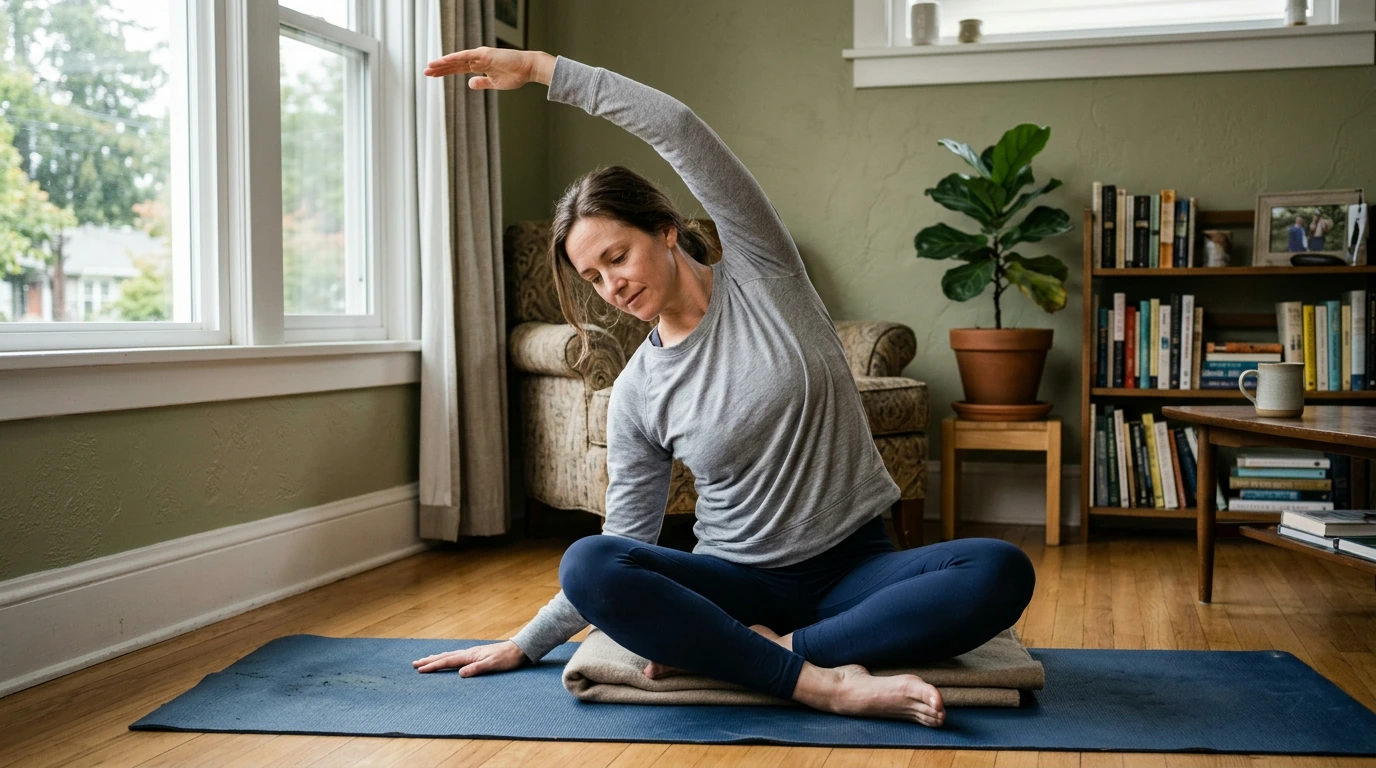
- Seated side bend
- Standing forward fold with bent knees
- Shoulder blade squeezes
Evening: downshift (6–12 minutes)
- Legs up the wall
- Reclining bound angle (supported)
- Supine twist
- Longer exhales
- 2 minutes of stillness
Desk-friendly option (2–4 minutes)
- Ankle circles
- Wrist stretches
- Seated cat-cow
- Neck release
- 3 rounds of slow breathing
Consistency tip: Attach each mini-routine to a cue—coffee brewing, computer shutdown, or a bedtime alarm.
Make it safe, comfortable, and sustainable
For a straightforward overview of yoga safety and basics, the National Center for Complementary and Integrative Health (NCCIH) is a reliable starting point. For broader context on why regular movement matters, see the CDC’s benefits of physical activity.
Keep yoga enjoyable: track progress without pressure
A calm next step: follow a beginner-friendly guide
FAQ
How often should a beginner do yoga if it’s a hobby?
A practical starting range is 2–4 times per week, with a 5–10 minute minimum session you can use on busy days. Consistency builds comfort and confidence faster than pushing intensity.
Is 10 minutes of yoga a day enough to see benefits?
Yes—short sessions repeated regularly can improve mobility, body awareness, and how you respond to stress. Many beginners do best by mixing quick “micro-sessions” with one or two slightly longer practices each week.
What should a beginner yoga routine include?
A simple routine works best: a brief breathing/arrival, a gentle warm-up, a few standing or floor poses, a cool down, and a short rest. Keep breathing steady and use modifications so the practice stays comfortable.
Recommended for you




Leave a comment